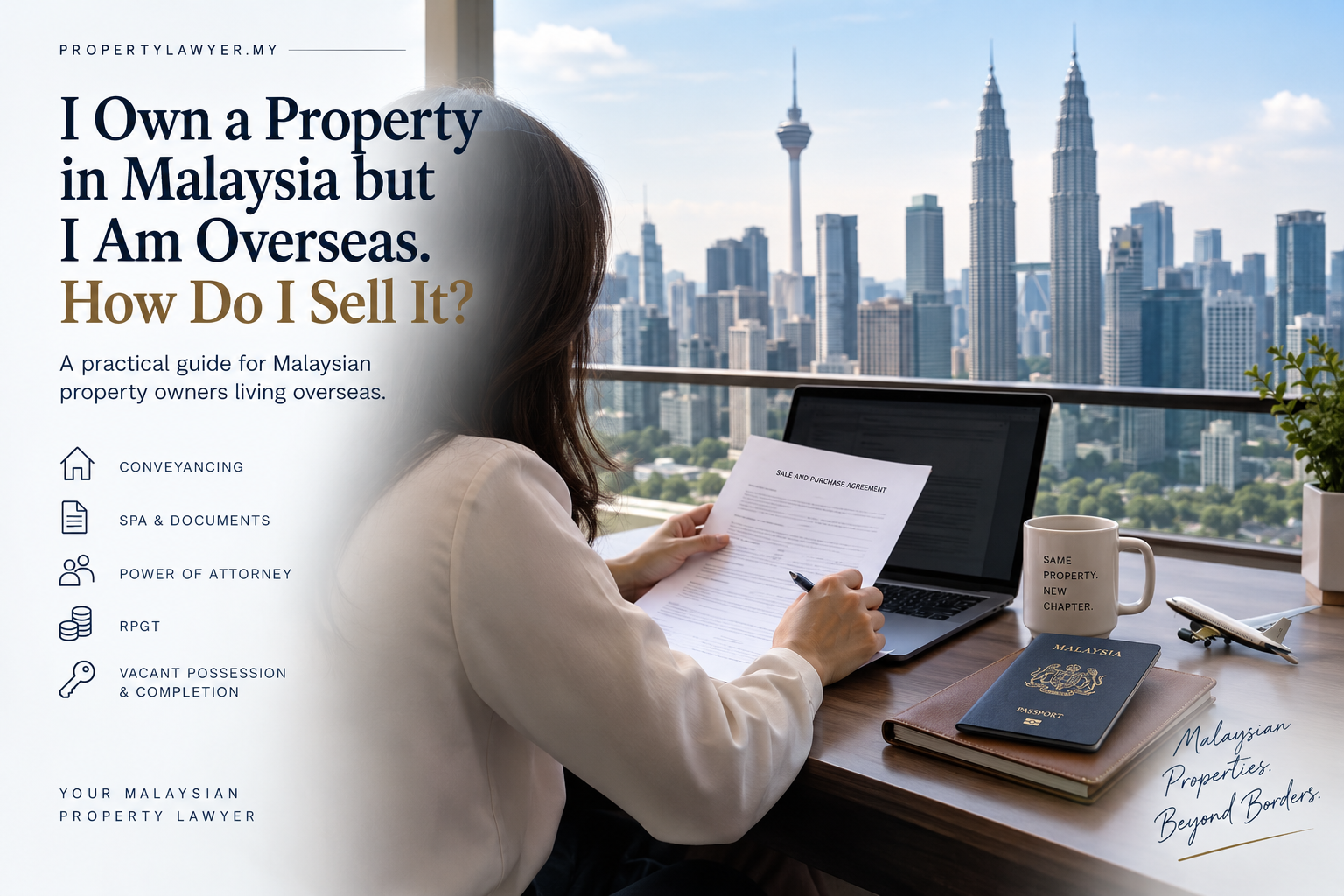

You can sell Malaysian property while overseas, and you do not necessarily have to return to Malaysia to complete the transaction.
If you own a property in Malaysia but are currently living overseas, one of the first questions that may come to mind is:
“How can I sell my Malaysian property without coming back to Malaysia?”
Can I Sell Malaysian Property While Overseas Without Coming Back to Malaysia?
Of Course. Being physically outside Malaysia does not, by itself, prevent you from selling your Malaysian property.
A Malaysian conveyancing solicitor can generally assist with the legal process in Malaysia, including:
- preparing and reviewing the Sale and Purchase Agreement (“SPA”) and other transfer documents;
- conducting the necessary title and property searches;
- liaising with the purchaser’s solicitors;
- liaising with your Financier/Bank and arranging redemption of an existing loan;
- dealing with the relevant developer, bank or management body on your behalf;
- preparing the necessary transfer and completion documents;
- attending to Real Property Gains Tax (“RPGT”) matters;
- extracting the necessary bills/statements for the management office, electricity, water, indah water and others;
- dealing with consent requirements where applicable; and
- completing the transaction and arranging for the sale proceeds to be paid to you.
The Malaysian Bar has also highlighted that sellers should prepare the relevant property documents and information at the beginning of a transaction because having the necessary documents can help the solicitors identify and resolve issues more efficiently.
The important point is that you do not necessarily need to return to Malaysia simply because you own a property here.
Do I Need a Power of Attorney to Sell My Malaysian Property?
Not necessarily.
Whether a POA is appropriate depends on the circumstances of the sale and the documents that need to be executed.
A POA can be useful where the owner wants another person in Malaysia to act on his or her behalf. For example, an owner living in Australia, Singapore, the United Kingdom, China or the United States may appoint a person in Malaysia to carry out specified acts in connection with the property transaction.
A POA should not, however, be treated as a simple form that can be downloaded and signed without legal advice.
The authority given to the attorney should be carefully drafted to cover the actions that the attorney is actually authorised to undertake.
For transactions involving land in Peninsular Malaysia, the National Land Code contains specific requirements concerning instruments executed under a Power of Attorney, including the documents that must accompany an instrument presented for registration.
The Malaysian Courts also provide guidance on the registration of Powers of Attorney. A POA executed outside West Malaysia has specific witnessing requirements, and a registrable POA must generally be in the National Language or English, subject to the applicable translation requirements.
Can I sign the SPA and the other transfer documents overseas?
Yes, but the witnessing and attestation requirements must be followed correctly.
This is particularly important for documents used in Malaysian conveyancing.
The Malaysian Bar’s guidance on executing conveyancing documents overseas notes that different types of documents can have different attestation requirements, including documents under the National Land Code, statutory declarations and Powers of Attorney.
Therefore, before signing anything overseas, it is advisable to ask your Malaysian solicitor to confirm:
- which documents need to be signed;
- who must witness or attest the documents;
- whether notarisation is required;
- what pen can be used to sign;
- whether any additional authentication or legalisation is necessary.
Do not sign the documents first and ask the lawyer later.
An incorrectly executed document can cause unnecessary delay and additional costs.
How to Sell Malaysian Property While Overseas: Step-by-Step
The exact procedure depends on the property and transaction, but a typical sale may proceed as follows.
Step 1: Appoint a Malaysian Property Lawyer
The first step is to appoint a Malaysian solicitor to handle the conveyancing transaction.
Ideally, you should appoint your own solicitor rather than simply using the solicitor recommended by the purchaser or property agent. Your solicitor can review your ownership documents and advise you on the transaction before you commit to the sale.
Step 2: Provide Your Property Documents
Your solicitor will generally need information and documents relating to the property.
Depending on the circumstances, these may include:
- copy of the title or strata title;
- previous Sale and Purchase Agreement;
- identity documents;
- latest quit rent (cukai tanah);
- latest assessment (cukai taksiran);
- bank loan documents;
- latest loan statement;
- maintenance and sinking fund information;
- information relating to the existing tenant, if the property is rented;
- documents relating to any previous transfer, inheritance or estate administration.
Not every transaction will require all of these documents. Your solicitor would advise you, review the documents and determine what is required for your particular property.
Step 3: Find a Buyer and Agree on the Sale Price
Once a buyer has been found, the parties will generally proceed with the SPA.
The SPA will set out matters such as:
- the purchase price;
- deposit;
- balance purchase price;
- completion period;
- late payment interest;
- conditions of sale;
- consent requirements;
- existing charge or financing;
- vacant possession or tenancy arrangements; and
- other obligations of the seller and purchaser.
If you are overseas, your solicitor should explain the important terms to you before you sign.
Step 4: Sign the Sale and Purchase Agreement
One of the common concerns of overseas owners is:
“Do I have to fly back to Malaysia just to sign the SPA?”
Not necessarily.
The appropriate signing arrangements depend on the transaction and the documents involved.
Your solicitor would advise you exactly how the SPA and other documents are to be executed overseas.
Step 5: Deal With Consent Requirements
Some properties cannot simply be transferred to the purchaser without obtaining the necessary consent or approval.
For example, the transaction may involve:
- state authority consent;
- restriction in interest;
- developer’s consent;
- management corporation or joint management body matters;
- leasehold property requirements;
- foreign ownership restrictions; or
- other restrictions appearing on the title.
This is why a title search and proper legal review should be carried out before assuming that the sale will proceed in exactly the same way as an ordinary property transaction.
Step 6: Deal With RPGT
Another important issue for an overseas property owner is Real Property Gains Tax (“RPGT”).
RPGT is generally imposed on gains arising from the disposal of Malaysian real property, subject to the applicable rules, exemptions and rates.
Importantly, living overseas does not automatically mean that you are treated as a non-citizen for RPGT purposes.
The RPGT classification depends on the relevant statutory category.
For example, the Inland Revenue Board of Malaysia (“LHDN”) categorises an individual who is not a Malaysian citizen and not a permanent resident under Part III of Schedule 5 to the RPGT Act. For such a disposer, the current RPGT rate is 30% for a disposal within five years and 10% from the sixth year onwards.
For a Malaysian citizen, the applicable RPGT treatment can be different. From 1 January 2022, an individual falling under Part I who disposes of a chargeable asset after five years is generally not subject to RPGT, subject to the applicable statutory provisions and exemptions.
Your solicitor or tax adviser should determine the applicable treatment based on your status and the property transaction.
What About the 3% or 7% Retention?
This is another area that overseas sellers frequently misunderstand.
The purchaser may be required to retain and remit an amount to LHDN under the RPGT legislation.
The applicable percentage depends on the category of the disposer.
For example, LHDN’s current materials state that the applicable retention can be 3% for certain disposers, while 7% applies to an individual who is not a Malaysian citizen and not a permanent resident, subject to the applicable statutory provisions.
RPGT Forms Must Also Be Submitted
LHDN states that the disposer and acquirer are responsible for submitting the relevant CKHT forms within 60 days from the date of disposal/acquisition, and online submission through the MyTax e-CKHT system has been mandatory since 1 January 2025.
This is another reason why an overseas seller should appoint professionals who are familiar with Malaysian property transactions.
What Happens to the Sale Proceeds?
After completion of the transaction and settlement of the relevant amounts, the balance sale proceeds can generally be paid to the seller.
If you are overseas, you should inform your solicitor at the beginning of the transaction about your preferred payment arrangements.
Your solicitor may need to verify:
- your bank account details;
- the identity of the account holder;
- whether the account is in Malaysia or overseas;
- whether there is an existing bank loan;
- whether there are outstanding sums payable; and
- whether any tax or statutory deductions apply.
If you are expecting a substantial amount of money to be remitted overseas, you should also check with your bank regarding its requirements for receiving or transferring the funds.
How Do I Deliver Vacant/Legal Possession If I Am Overseas?
Being overseas does not prevent you from delivering vacant possession of a Malaysian property.
You do not necessarily have to fly back to Malaysia just to hand over the keys. The sale and purchase agreement can provide for vacant possession to be delivered through your solicitors, an authorised representative or agent.
Example:
You are a Malaysian who now lives in Oman and own a property in Kuala Lumpur. You have sold the property and you do not need to fly back to Malaysia merely to hand over the keys. Your solicitor can structure the transaction so that, upon full payment of the purchase price, the keys and access devices are released to the purchaser’s solicitors or an authorised representative in Malaysia. You can therefore complete the sale and deliver vacant possession without being physically present in Malaysia.
One important distinction: if the property is still occupied by a tenant and the property is to be sold together with the tenancy, this is generally not a vacant possession situation. The SPA would instead properly deal with delivery of legal possession subject to the existing tenancy, including the tenant, rental and security deposit.
What Documents Should I Prepare Before Contacting a Malaysian Property Lawyer?
If you are overseas and want to sell your Malaysian property, it is useful to prepare the following information:
Property
- Property address
- Title / strata title, if available
- Previous SPA
- Date of purchase
- Original purchase price
- Current estimated selling price
Seller
- NRIC / passport
- Citizenship
- Current overseas address
- Contact details
- Malaysian correspondence address, if any
Financing
- Name of bank
- Latest loan statement
- Outstanding loan amount
- Loan account details
Property Management
- Maintenance statement
- Sinking fund statement
- Assessment / quit rent information
- Tenancy agreement, if applicable
Tax
- Original acquisition documents
- Legal fees and other relevant acquisition expenses
- Relevant disposal expenses
- Previous CKHT/RPGT information, if applicable
Providing these documents early can allow your solicitor to identify potential problems before the SPA is signed.
Common Questions From Overseas Property Owners
Can a Malaysian living in Singapore/Australia/UK/Japan/Thailand/other Countries sell a Malaysian property without coming back?
Yes. The transaction can often be coordinated while the owner remains in Singapore. However, all documents relating to the sale must be properly executed in accordance with the applicable Malaysian laws and requirements, particularly where the documents require witnessing, attestation, notarisation, certification and/or execution before the relevant authority.
Do I need a Power of Attorney to sell my Malaysian property?
Not necessarily.
If I live overseas, am I automatically a non-resident for RPGT?
No. RPGT treatment depends on the statutory category applicable to you. In particular, Malaysian citizenship and permanent resident status are relevant to the RPGT classification.
Do I have to return to Malaysia to sign the documents?
Not necessarily. However, all documents relating to the sale must be properly executed in accordance with the applicable Malaysian laws and requirements, particularly where the documents require witnessing, attestation, notarisation, certification and/or execution before the relevant authority.
Can I appoint a lawyer to sell the property for me?
A lawyer can handle the legal aspects of the transaction.
Conclusion: Selling a Malaysian Property From Overseas Is Possible
Owning a property in Malaysia does not mean that you have to return to Malaysia simply because you want to sell it.
For many overseas owners, the transaction can be managed with the assistance of a Malaysian conveyancing solicitor, together with appropriate arrangements for signing documents and, where necessary, a Power of Attorney.
However, every property transaction is different.
The best approach is to speak to a Malaysian property lawyer before you sign any sale documents, so that the transaction can be structured properly from the beginning.
Need Help Selling Your Malaysian Property From Overseas?
Our conveyancing lawyers can assist Malaysian property owners who are currently overseas with the sale of residential and commercial properties in Malaysia, including the preparation and execution of transaction documents, coordination with banks and purchasers, Power of Attorney arrangements, and completion of the conveyancing process.
Whether you are living in Singapore, Australia, the United Kingdom, China, Taiwan, Hong Kong, Oman or elsewhere, our team can communicate with you in English or Mandarin and coordinate the Malaysian legal process with you remotely.