
Choosing the right contracts for SMEs in Malaysia can help business owners establish clearer rights and obligations when dealing with employees, shareholders, customers, landlords and business partners.
Many business relationships begin with a simple conversation, WhatsApp message or handshake. While trust is important in business, relying entirely on informal arrangements can create difficulties when circumstances change or a disagreement arises.
A properly drafted contract helps establish the rights and obligations of the parties and provides a clear framework for dealing with potential problems.
However, not every SME needs exactly the same contracts. The appropriate agreements depend on the nature of the business, its ownership structure, employees, premises and commercial activities.
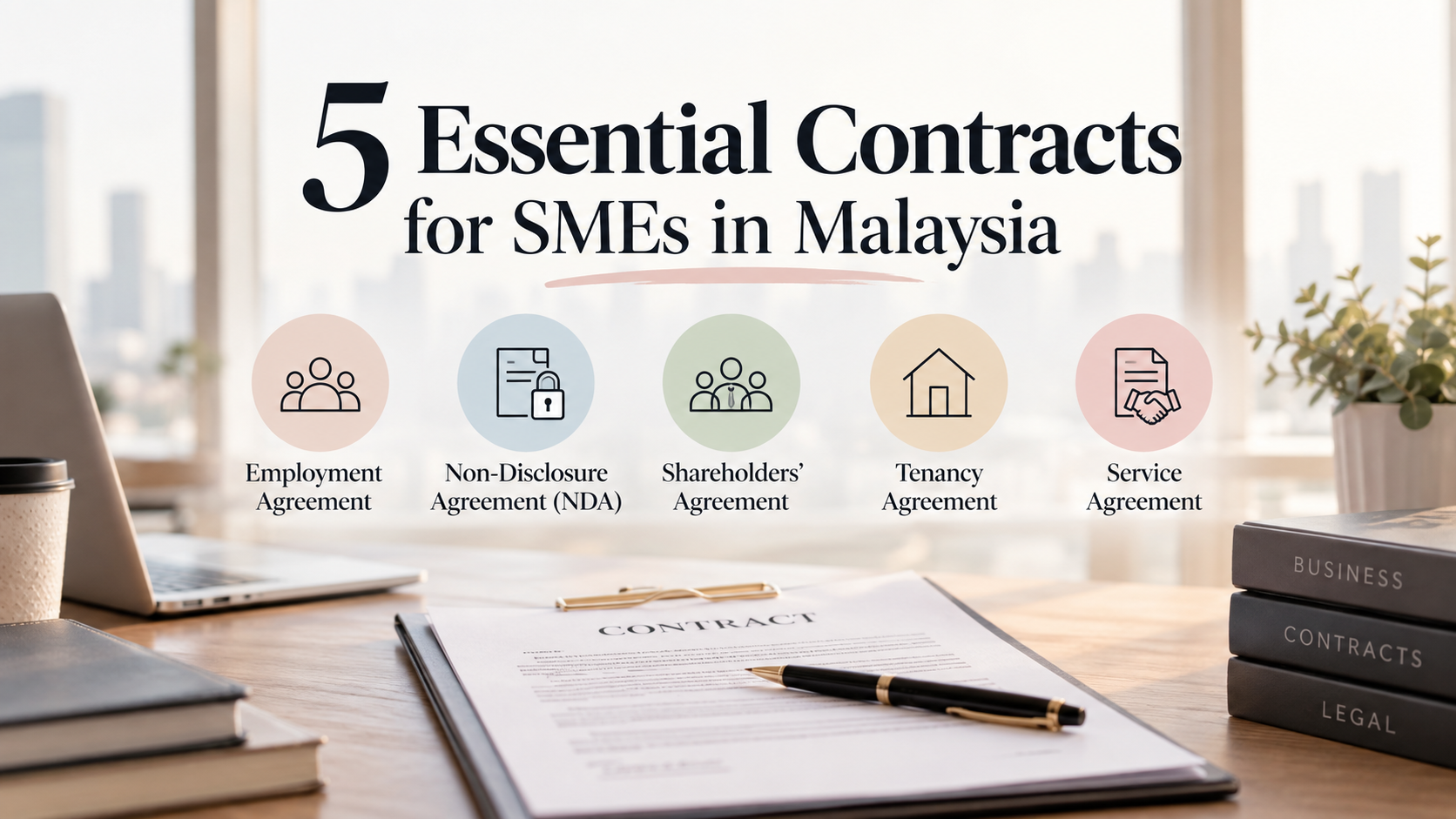
Here are five important agreements that Malaysian SMEs should consider.
1. Employment Agreement
What is an Employment Agreement?
An employment agreement is a contract between an employer and an employee setting out the terms and conditions of employment.
Depending on the position and circumstances, an employment agreement will cover:
- Job title and responsibilities;
- Salary and remuneration;
- Working hours;
- Probation period;
- Leave and benefits;
- Notice period;
- Termination;
- Confidentiality;
- Intellectual property; and
- Other employment obligations.
For Malaysian SMEs, the terms should be prepared with regard to the applicable employment laws and the particular circumstances of the employee.
Why is it important?
A written employment agreement can help both the employer and employee understand their respective rights and obligations.
For an SME, it can provide greater clarity on:
- What the employee is expected to do;
- How remuneration is calculated;
- What happens during probation;
- The applicable notice period;
- Termination arrangements;
- Confidentiality obligations; and
- Ownership of intellectual property created during employment.
Clear contractual terms can reduce misunderstandings and provide a reference point if a dispute arises.
What happens if there is no Employment Agreement?
Without properly documented terms, the employer and employee may have different understandings about their respective obligations.
For example, a disagreement may arise over:
- Notice period;
- Job responsibilities;
- Benefits;
- Confidentiality;
- Termination;
- Ownership of work product; or
- Other employment terms.
The absence of clear written terms can make an employment dispute more difficult to manage.
Legal Fees
The legal fee for preparing an employment agreement depends on the complexity of the position and the level of customisation required.
A solicitor can provide a quotation after understanding the SME’s requirements.
2. Non-Disclosure Agreement (NDA)
What is an NDA?
A Non-Disclosure Agreement (“NDA”) is an agreement designed to protect confidential information disclosed between parties.
An SME may possess commercially sensitive information such as:
- Customer information;
- Pricing;
- Business strategies;
- Financial information;
- Product information;
- Marketing plans;
- Technical information;
- Trade secrets; and
- Other confidential business information.
An NDA establishes contractual obligations concerning the use and disclosure of such information.
Why is it important?
Information can be one of an SME’s most valuable business assets.
A company may spend years developing its customer base, pricing strategy, business processes and commercial know-how.
An NDA helps establish a contractual framework for protecting confidential information when it is disclosed to another party.
It also makes the parties’ expectations clear from the beginning.
What happens if there is no NDA?
Without an NDA, an SME may face a difficult situation if its confidential or proprietary information is disclosed to another party and subsequently leaked, misused or disclosed to third parties. For example, an SME may disclose its business plans, pricing strategies, customer information, product designs, trade secrets or other commercially sensitive information to a potential business partner during negotiations.
If there is no NDA or other contractual confidentiality obligation, the SME may not have a specific contractual agreement that restricts the other party from using or disclosing that information.
By having an NDA in place, the SME can establish clear contractual obligations restricting the other party from using, disclosing or misusing the confidential information.
If the other party breaches the NDA, the SME may, depending on the circumstances and applicable legal requirements, seek appropriate legal remedies. These may include an application for an injunction to restrain further use or disclosure of the confidential information, as well as other remedies that may be available for the breach.
Therefore, an NDA is not merely a document recording that information is “confidential”. It can provide the SME with a contractual basis for taking action if confidential information is improperly used or disclosed.
Legal Fees
The legal fee for an NDA depends on its scope and complexity.
A simple NDA may be relatively straightforward. However, a more comprehensive NDA may require additional drafting where there are:
- Multiple parties;
- Significant confidential information;
- Complex permitted-use provisions;
- Specific confidentiality periods;
- Intellectual property considerations; or
- Cross-border elements.
The solicitor can provide a quotation after reviewing the intended transaction.
3. Shareholders’ Agreement
What is a Shareholders’ Agreement?
A shareholders’ agreement is an agreement between shareholders dealing with matters relating to the ownership and management of a company.
It is particularly useful for companies with two or more shareholders.
A shareholders’ agreement may address:
- Share ownership;
- Decision-making;
- Appointment of directors;
- Funding;
- Dividends;
- Transfer of shares;
- Rights of existing shareholders;
- Exit arrangements;
- Deadlock;
- Death or incapacity of a shareholder; and
- Sale of the business.
Why is it important?
For many SMEs, the business may be controlled by only a small number of shareholders.
A disagreement between shareholders can therefore have a significant impact on the operation of the company.
A shareholders’ agreement can establish in advance:
Who makes important decisions, how decisions are made and what happens when shareholders disagree or one of them wants to leave.
It can also provide mechanisms dealing with transfers of shares and other significant events affecting the ownership of the company.
What happens if there is no Shareholders’ Agreement?
Without a shareholders’ agreement, shareholders may find themselves relying on the company’s constitution, applicable legislation and other legal arrangements, depending on the circumstances.
However, these may not necessarily address every commercial expectation between the shareholders.
For example, the shareholders may never have agreed on:
- How a shareholder can exit;
- Whether existing shareholders have a right to acquire shares being sold;
- How a deadlock should be resolved;
- What happens if a shareholder dies; or
- How a proposed sale of the business should be handled.
These issues can become particularly difficult once the shareholders are already in disagreement.
A shareholders’ agreement is therefore often best considered before a dispute arises.
Legal Fees
The legal fee for preparing a shareholders’ agreement is usually affected by the complexity of the company’s ownership and management arrangements.
A bespoke shareholders’ agreement generally requires more detailed consideration than a straightforward precedent because the agreement should reflect the actual commercial relationship between the shareholders.
4. Tenancy or Commercial Lease Agreement
What is a Tenancy or Commercial Lease Agreement?
An SME operating from an office, shop, warehouse, factory or other commercial premises will usually need an agreement governing its occupation of the premises.
Depending on the arrangement, this may take the form of a tenancy agreement or lease.
The agreement may cover:
- Rental;
- Security deposit;
- Tenancy or lease period;
- Renewal;
- Permitted use;
- Maintenance;
- Utilities;
- Renovation;
- Repairs;
- Insurance;
- Assignment or subletting;
- Termination; and
- Reinstatement of the premises.
Why is it important?
For many SMEs, the business premises are essential to the operation of the business.
A shop may depend on its location to attract customers. A warehouse may be essential for storing inventory. An office may be necessary for the company’s operations.
A properly drafted agreement can help clarify matters such as:
- How much rent is payable;
- Who is responsible for repairs;
- Whether alterations are permitted;
- Whether the premises can be sublet;
- What happens at the end of the tenancy; and
- When either party can terminate.
What happens if there is no proper Tenancy or Lease Agreement?
Without clear contractual terms, disputes may arise over matters such as:
- Rental;
- Security deposit;
- Repairs;
- Maintenance;
- Renovation;
- Permitted use;
- Termination; and
- Reinstatement.
This can be particularly disruptive where the premises are essential to the business.
Legal Fees
Legal fees for a tenancy or commercial lease depend on factors such as:
- Rental amount;
- Duration of the tenancy.
An SME should consider obtaining a quotation based on the actual tenancy or lease terms before instructing a solicitor.
5. Service Agreement / Terms and Conditions
What is a Service Agreement?
A service agreement sets out the terms under which a business provides services to its customer.
Depending on the business, it may be a formal service agreement, master service agreement or a set of terms and conditions.
It may address:
- Scope of services;
- Fees;
- Payment terms;
- Deliverables;
- Timelines;
- Customer responsibilities;
- Variations;
- Intellectual property;
- Confidentiality;
- Liability;
- Termination; and
- Dispute resolution.
The appropriate form will depend on the nature of the SME’s business.
Why is it important?
One of the most common sources of commercial disagreement is a difference in expectations.
The customer may believe that a particular service is included within the agreed fee, while the service provider may consider it additional work.
A properly drafted service agreement can clarify:
- What is included;
- What is excluded;
- How much the customer must pay;
- When payment is due;
- How additional work is charged;
- What happens if the customer cancels; and
- What happens if either party fails to perform its obligations.
This can provide greater certainty for both the business and its customers.
What happens if there is no Service Agreement?
Without clear terms, disagreements may arise over the scope of work, fees, deadlines and responsibilities.
For example:
A customer asks a company to perform additional work and later argues that the additional work was already included in the original quotation.
If the scope of work and variation mechanism were never properly documented, resolving the disagreement may become more difficult.
A written service agreement or clear terms and conditions can help establish the parties’ respective expectations from the beginning.
Legal Fees
The legal fee depends on the nature and complexity of the services being provided.
A solicitor can provide a quotation after reviewing the SME’s business model and requirements.
How Much Does It Cost to Prepare an SME Contract?
There is no single legal fee that applies to every SME contract.
The legal fee will depend on the type of agreement and the amount of legal work required.
Factors that may affect the fee include:
- Type of agreement
- Complexity of the transaction
- Number of parties involved
- Whether a precedent can be adapted
- Amount of negotiation required
- Number of revisions
- Whether additional legal documents are required
For example, a straightforward NDA may require substantially less work than a bespoke shareholders’ agreement involving several shareholders, detailed exit arrangements and extensive negotiations.
For this reason, SMEs should consider obtaining a quotation from a solicitor after explaining the nature of the transaction and the scope of work required.
Don’t Wait Until a Dispute Arises
One of the common mistakes made by business owners is reviewing their contracts only after something goes wrong.
By then, the business may discover that:
- The payment terms were unclear;
- There was no clear termination mechanism;
- Confidentiality obligations were inadequate;
- Ownership of intellectual property was not addressed;
- Shareholders had never agreed on an exit mechanism; or
- The parties had different understandings about their respective obligations.
A contract is generally most useful before a dispute arises.
The purpose of a good agreement is not necessarily to anticipate that the parties will fall out. It is to establish clear expectations and provide a framework for dealing with changes and disagreements if they occur.
Conclusion
Contracts are not merely paperwork for large corporations. For Malaysian SMEs, appropriate agreements can help establish clarity over some of the most important aspects of running a business — people, ownership, confidentiality, premises, services, money and risk.
The five agreements discussed in this article are not suitable for every SME in every situation. The appropriate documentation depends on the business model, ownership structure and particular commercial arrangements.
Before signing an important agreement, an SME should consider obtaining legal advice to ensure that the terms properly reflect the intended commercial arrangement and applicable Malaysian law.
Need Help With Your SME Contracts?
Our corporate and commercial lawyers assist Malaysian SMEs with the drafting, review and negotiation of commercial agreements, including employment agreements, NDAs, shareholders’ agreements, tenancy agreements, service agreements and other business contracts.
If your business is entering into an important agreement, speak to a lawyer before signing.
Contact Tam Yuen Hung & Co. for a quotation based on your specific requirements.