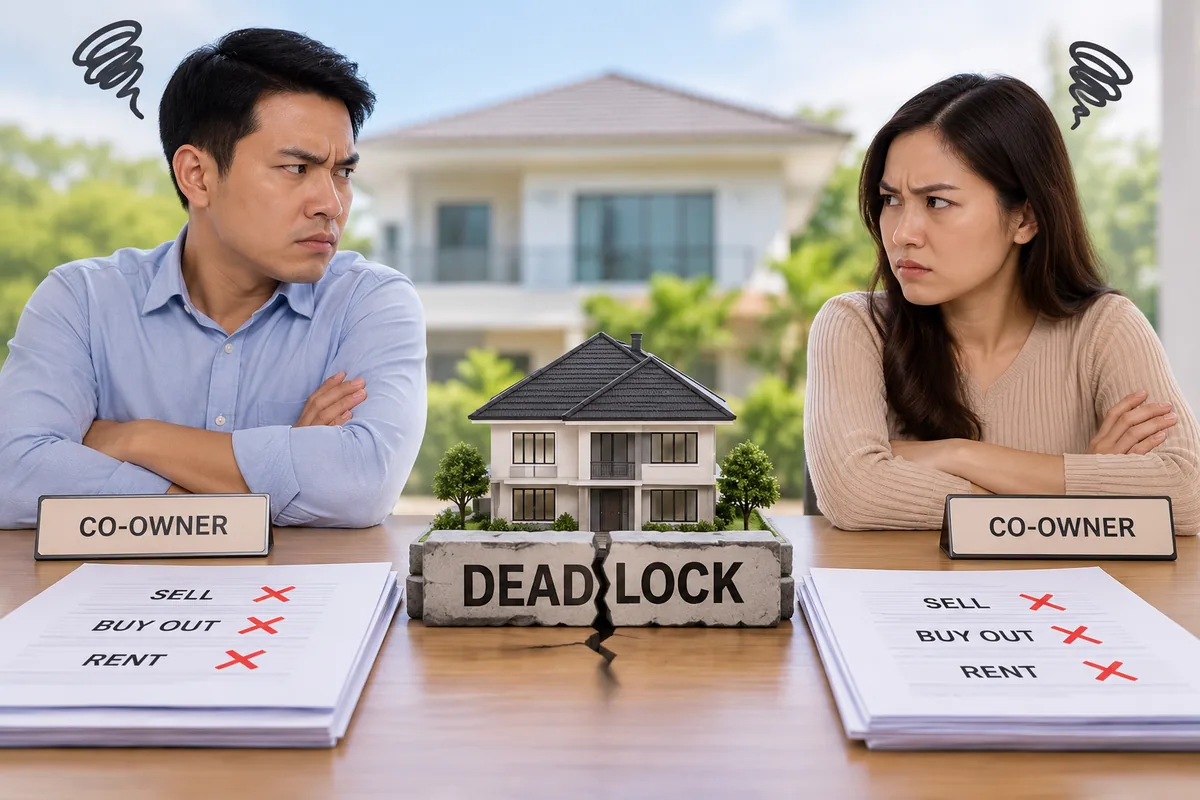

Jointly owned property in Malaysia can arise when two or more people purchase a property together, whether they are spouses, siblings, parents and children, business partners, friends or investors. Both parties may contribute towards the purchase price and have their names registered on the title. While co-ownership may work well initially, disputes can arise when the co-owners no longer agree on what should happen to the property.
Situations which may arise:-
- One co-owner wants to sell but the other refuses
- One person is living in the property while the other is not receiving anything
- One co-owner is using the entire property for a business and refuses to pay anything to the other co-owner
- The relationship between the co-owners has completely broken down and both can no longer manage the property together
When any of these situations arise, the co-owners may find themselves in a deadlock. A deadlock can be particularly difficult where neither party is willing to compromise.
So, what can you do when you are stuck in a deadlock with your co-owner?
This is where understanding your rights as a co-owner — and the remedies available under Malaysian law — becomes important.
Jointly Owned Property Malaysia: Frequently Asked Questions
1. What Rights Do Co-Owners Have in Jointly Owned Property Malaysia?
Section 343 of the National Land Code provides that where land is vested in two or more co-proprietors, their shares are deemed to be equal unless different proportions are specified in the memorial of registration.
It also provides that, while the co-proprietorship continues, each co-proprietor is entitled to possession and enjoyment of the whole property.
If you own ½ of a property together with another person, the other co-owner generally cannot simply say:
“You only own ½, so you cannot use my side of the property.”
The legal position is more complicated because the shares are undivided shares.
Likewise, one co-owner should not simply assume that because he or she is physically occupying the property, the other co-owner has no rights over it.
2. Can One Co-Owner Sell a Jointly Owned Property?
No, a co-owner cannot sell the property without the agreement of the other co-owner. Where the property is jointly owned, both co-owners will generally need to agree to the sale and execute the necessary documents.
3. Can I sell my 50% share in a jointly owned property?
Yes it is possible if the buyer is agreeable to buy your undivided share in the property without affecting the other co-owner’s share, subject to the National Land Code, any restriction in interest, existing charge or other legal restrictions affecting the property.
A negotiated buy-out or sale of the entire property may sometimes be more practical.
4. What can I do if I no longer want to own the property with the other co-owner?
If you no longer wish to continue owning a property with another person, you are not necessarily required to remain in the co-ownership indefinitely.
Depending on the circumstances, there are several possible options.
1. Sell the property together
The simplest solution is for both co-owners to agree to sell the property and divide the net sale proceeds according to their respective interests.
2. Ask the other co-owner to buy your share
If the other co-owner wishes to retain the property, you may negotiate for that co-owner to buy your undivided share. For example, if both parties own ½ of a property, one party may purchase the other’s ½ interest based on an agreed valuation.
3. Apply to the Court to terminate the co-proprietorship
Where the co-owners cannot agree and one co-owner refuses to cooperate, section 145 of the National Land Code 1965 provides an important remedy.
The Court may, in the circumstances set out in the section, make an order to enable the co-proprietorship to be terminated. This can include an order that the undivided share of one co-owner be transferred to another co-owner, or that the land be sold.
This is particularly relevant where the parties have reached a deadlock and the co-ownership can no longer reasonably continue.
For example:
A and B each own ½ of a property. A no longer wants to remain a co-owner and asks B to buy A’s share. B refuses. A then asks B to agree to sell the property, but B also refuses. In such circumstances, A may have grounds to consider an application to the Court under section 145, depending on the facts.
5. What if one co-owner is using the entire property?
This is one of the most common problems.
Imagine:
A and B each own ½ of a shoplot.
A operates his business from the entire shoplot.
B does not use the property at all.
A refuses to sell the property.
The question then becomes:
Does B simply have to accept the situation?
Not necessarily.
As co-proprietors, both parties have rights in relation to the property. Section 343 recognises each co-proprietor’s entitlement to possession and enjoyment of the whole while the co-proprietorship continues.
Depending on the facts and any agreement between the parties, there may also be a basis for a claim relating to occupation, rental or compensation.
This is particularly important where one co-owner has effectively excluded the other from the economic benefit of the property.
However, the entitlement to rental or compensation is fact-specific and should not simply be assumed because one co-owner is occupying the property.
The parties’ agreement, the circumstances of occupation, payments made, communications between the parties and other evidence may all become relevant.
6. Can I claim rental from my co-owner?
Yes, but must be supported by agreement.
If there is an agreement that the occupying co-owner will pay rent for the use of the other co-owner’s interest, the unpaid rental may potentially be recoverable. However, the precise legal basis of the claim depends on the facts.
Evidence such as written agreements, WhatsApp messages, bank transfers, cheques, payment vouchers and correspondence can be important in establishing the existence and terms of the rental arrangement.
7. Can a Co-Owner Refuse to Sell the Property?
Yes. If one co-owner applies to the Court for an order to terminate the co-proprietorship and sell the property, the other co-owner is entitled to oppose the application and explain why he or she does not want the property to be sold.
For example, the co-owner may argue that:
- he wants to continue owning the property;
- he is willing to buy the other co-owner’s share;
- the property should be partitioned instead;
- the proposed sale price is too low;
However, simply saying “I don’t want to sell” does not necessarily end the matter.
What the court would be considering is not simply:
“Does the other co-owner agree to sell?”
The more important question is:
“What order is just and appropriate to bring the co-proprietorship to an end in the circumstances of the case?”
If the Court considers that the co-ownership has reached a genuine deadlock and that a sale is the appropriate way to terminate the co-proprietorship, the Court may order the property to be sold even though one co-owner does not voluntarily agree to the sale
8. How to determine or decide the selling price?
The Court can give directions concerning the sale, including arrangements for determining the property’s value.
Depending on the circumstances, the Court may direct that a registered valuer be appointed to determine the property’s market value and may also give directions concerning the marketing and sale of the property.
The objective is to ensure that the sale is conducted in an appropriate and fair manner.
9. Can one co-owner buy the other co-owner’s share instead of selling the property?
Yes. A buy-out can sometimes be a practical alternative to selling the entire property.
For example, if A and B each own 50% of a property, A may agree to purchase B’s 50% interest at an agreed price.
The parties may obtain an independent valuation to help determine a fair price.
The transaction would then need to be properly documented and the relevant land, financing and stamp duty requirements considered.
10. What happens if the property cannot be sold?
A good sale mechanism should anticipate this possibility.
For example, an order may provide for the property to be marketed for a specified period.
If the property remains unsold, the parties may be required to obtain a fresh valuation or return to Court for further directions.
This is particularly useful because otherwise one co-owner may simply refuse to cooperate and argue:
“Nobody has bought the property, so nothing can happen.”
The Court can, depending on the circumstances, structure its order to reduce the possibility of one party frustrating the sale.
11. What if my co-owner refuses to sign the documents needed to sell the property?
This can be particularly problematic where the parties have already agreed to sell but one party subsequently refuses to cooperate.
Depending on the circumstances, it may be possible to seek specific directions or orders from the Court requiring the relevant court officer to sign on behalf of the co-owner to facilitate the sale.
12. What happens to the money after the property is sold?
The sale proceeds do not automatically mean that each party simply receives half of the gross purchase price.
There may first be deductions for matters such as:
- redemption of a bank loan;
- legal fees;
- estate agent’s commission;
- valuation fees;
- outstanding expenses; and
- other costs properly attributable to the sale.
The remaining net proceeds can then be distributed according to the parties’ respective interests, subject to any other orders or claims between the parties.
For example:
Sale price: RM1,000,000
Less outstanding bank loan and sale expenses: RM300,000
Net proceeds: RM700,000
If the parties each own ½, the starting position may be RM350,000 each, subject to any adjustments or competing claims.
13. What if the property is subject to a bank loan?
This needs to be considered carefully.
A co-owner cannot simply decide:
“I want to sell my share.”
There may be a charge registered in favour of the bank.
The outstanding financing, redemption sum and bank’s requirements will need to be addressed as part of the transaction.
The same applies if one co-owner has been paying substantially more towards the loan, renovation costs, maintenance charges or other expenses.
Those payments may become relevant to the parties’ financial claims against one another, depending on the circumstances.
14. If the co-owner dies, will his portion automatically become mine?
No. The deceased co-owner’s share does not automatically become yours merely because you are the other co-owner. Upon the death of a co-owner, his or her portion of the property will generally form part of the deceased’s estate and will be dealt with in accordance with the deceased’s Will or, where there is no Will, the applicable laws of distribution and succession.
Final thoughts
Owning a property with another person does not mean that you are permanently trapped in the arrangement.
If the relationship between co-owners breaks down, there may be legal avenues to address the situation, including partition, transfer of one co-owner’s undivided share, or an order for sale.
Section 145 of the National Land Code is particularly important where the co-proprietorship cannot otherwise be brought to an end and one co-owner refuses to cooperate.
However, every case is different.
Whether you should negotiate a buy-out, pursue partition, claim rental or compensation, or apply to Court for termination of co-proprietorship and sale will depend on the title, ownership structure, agreements between the parties, payments made and the overall circumstances.
If you are involved in a dispute concerning jointly owned property Malaysia, obtaining legal advice early can help you understand your available options.
This article is intended for general information only and does not constitute legal advice. The law and application of the law may differ depending on the facts of each case.